

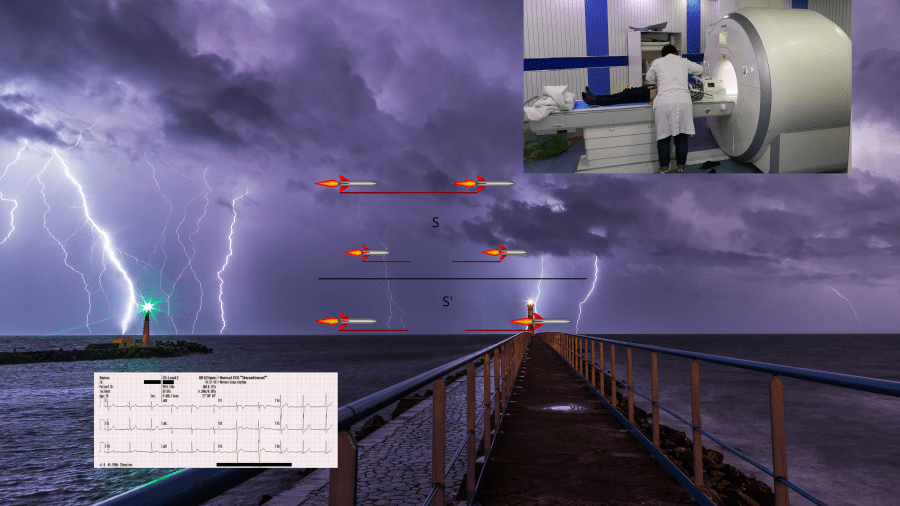
Students enrolled in PHYS 422 (Electromagnetism II) will present a project related to electromagnetism and relativity. Each presentation will be 10 minutes long, followed by 2-4 minutes of questions. Titles and abstracts are as follows.
Talk 1: Mo Alawami, The space contraction force on a cord connecting two super fast spaceships
Two spaceships are accelerating - at the same rate and for the same amount of time - to a significant percentage of the speed of light, connected by a cord. As their speed increases, they experience relativistic effects, such as space (Lorentz) contraction. To an observer on the ground, the distance between the spaceships will never change, but the contraction will be felt by the cord as a force. This leads to the question "will the cord break?" I'll attempt to answer that question, and show how using two charges and an electric field leads to the same results.
Talk 2: Braeden Carter, Using Electric Fields to localize and model lightning
Being able to properly model the atmosphere is a difficult task, since it’s a quite complex system with many moving pieces. By extension, this complexity also applies to thunderstorms and lightning. Meteorologists are always looking for more accurate and efficient methods to model thunderstorms and lightning. By being able to model these systems to a greater capacity, meteorologists are able to provide better and more accurate forecasts that will assist in protecting lives and saving critical infrastructure. In this presentation we will look at how lightning is modeled, the limitations that come with said model, and introduce a new method for analyzing lightning to help in improving the efficiency of the model and accuracy of meteorologist’s forecasts.
Talk 3: Matthew Whitehead, Radiation of Magnetic Dipoles In an Open Quantum System
The radiation emitted by precessing magnetic dipoles is essential to understand how an MRI forms images. By examining this process through a quantum lens, a Bloch vector was used to simulate these emissions and calculate radiated power. These results provided a direct link between the quantum mechanical description of the spin system and the measurable classical signals in an MRI detector.
Talk 4: KJ Lawrence, A Study of the Effects of Torso Inhomogeneities on Electrocardiographic Potentials
Heart imaging and monitoring are essential tools for understanding the function and behavior of one of the body's most vital organs. Electrocardiograms (ECGs) are a common method of heart monitoring that detect the heart's electrical activity and display it as waveforms. The electrical field created by the heart exists throughout the body and is detected by sensors placed on the body's surface; however, on its journey to the surface, the electric field must travel through several boundaries and layers of tissue. These boundaries have the potential to distort the signal that ECG machines detect and report to healthcare professionals.
A simulation study conducted by Gulrajani and Mailloux used 23 fixed dipoles to model the heart within a 3 cm thick torso model constructed from different tissue layers, each with its own conductivity. The simulation tested different tissue conditions to determine their effects on the surface potential.
The simulation calculated the potential produced along the torso's surface, which was then compiled into ECGs, vectorcardiograms, and body surface potential maps to discern the effects of each added tissue layer. Key findings were: The muscle layer decreases signal strength, the lungs have little effect, and the blood mass has the most significant effect, increasing and at times muffling the signal. These results align with actual physiological behavior, indicating the simulation accurately reflects real heart activity and body conditions. This model may be used to study more efficient modes of cardiac imaging.
