

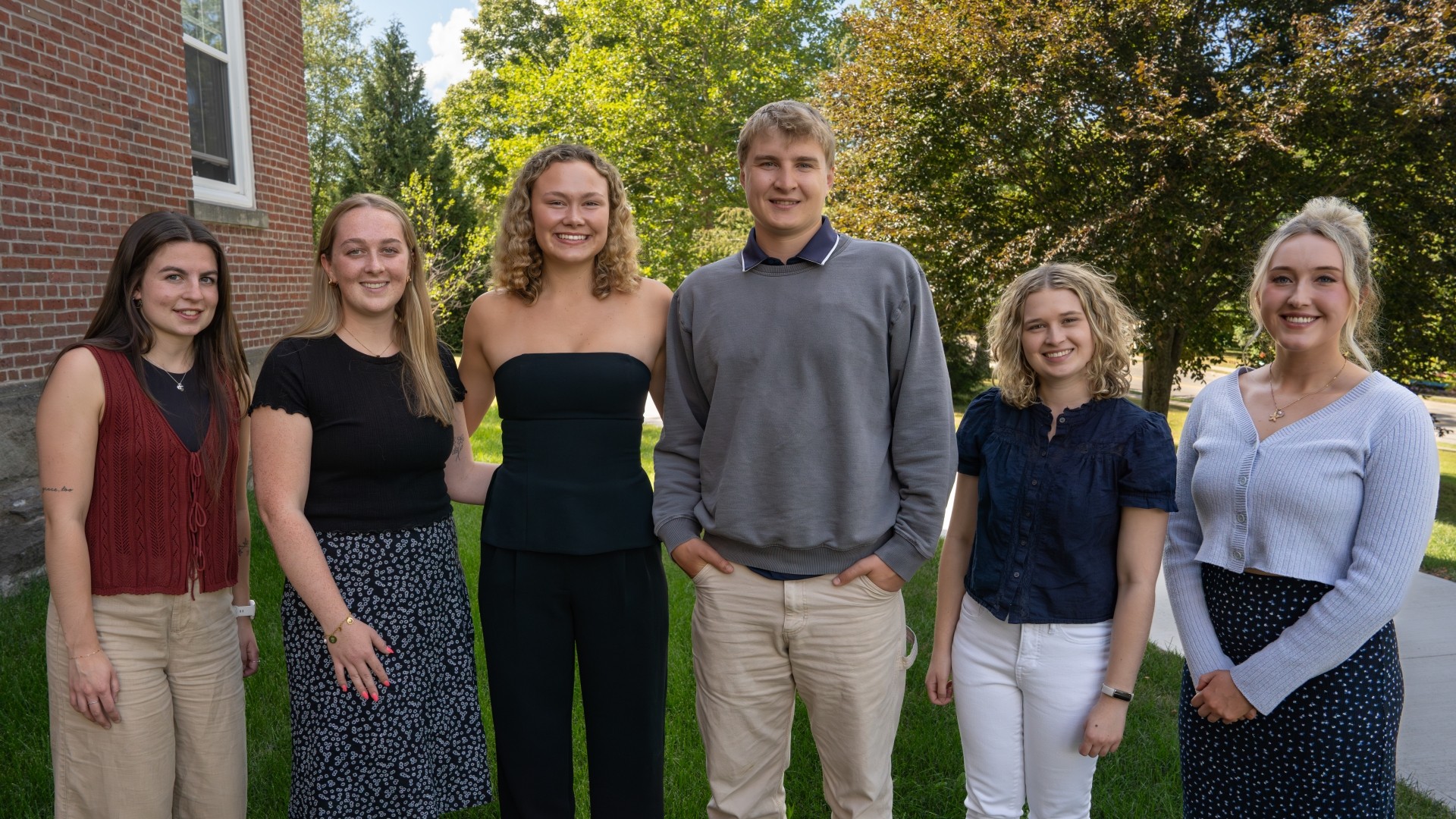
From investigating risk factors for intimate partner violence to book censorship in Atlantic Canada, and from Canada’s food school program to the importance of play in childhood, seven StFX students spent this past summer immersed in impactful research as recipients of the Irving Oil Research Mentorship Award.
Each Irving Oil Research Mentorship Award provides $9,000 in funding and an opportunity for StFX students to work on research under the supervision of a StFX faculty member.
This year’s recipients include Reese Mann, Abby Ives, Emily Richard, Abigail Jessome, Nick Panciuk, Leah Jackson and Samuel Goodine. The students say the experience provided an incomparable opportunity to make meaningful contributions to areas they’re passionate about, all while learning and growing themselves.
THE IMPORTANCE OF PLAY
“This summer has been an incredible way to dip my toes into the world of research. I have learned so much: how to design and conduct a study, how to obtain ethics approval, and how to conduct in-depth literature reviews. I feel incredibly grateful to have been a recipient of the Irving Oil Research Mentorship Award, to support this project and to be a student working under the leadership of Dr. Kara Thompson, an esteemed researcher,” says Reese Mann, a fourth-year honours BASc in Health student from Moncton, NB.
Ms. Mann conducted a qualitative study looking at how parents balance unstructured play and structured activities for their children. The project was a precursor to her honours thesis this school year.
Play is a crucial component of children's health, she says, where they learn to share, cooperate, negotiate, be creative, form social connections and have fun.
“Despite this, play has been declining over the past 60 years with children, who are now in more scheduled, adult-led extracurriculars, while also spending more time using technology,” says Ms. Mann.
Study objectives included understanding parental perceptions of play, identifying barriers and facilitators to play, in both urban and rural settings, understanding how parents balance structured and unstructured play and understanding how children’s schedules impact parents' lives.
Ms. Mann conducted a literature review and prepared materials for data collection. In October, she will conduct focus groups with parents from Moncton, NB, and Antigonish, NS, to compare rural and urban parental perceptions of play. She will present her results at Student Research Day and defend her thesis in the spring.
After graduation, Ms. Mann is interested in pursuing an MSc in occupational therapy to become a pediatric play-based occupational therapist. She says this project instilled a further passion for childhood health, and the implications societal changes make on their upbringing.
After graduation, Ms. Mann is interested in pursuing an MSc in occupational therapy to become a pediatric play-based occupational therapist. She says this project instilled a further passion for childhood health, and the implications societal changes make on their upbringing.
“I am fascinated by the world of play, and the value it contributes for healthy development,” she says.
“The freedom to design and conduct an independent research project has been and continues to be such a privilege,” adds Ms. Mann. “Having an idea and bringing it to life is so meaningful, and I cannot wait for data collection. I am very keen to hear firsthand how play and structured activities fit into the lives of children and parents. Getting to meet one-on-one with my supervisor, being immersed in a research lab setting and getting a head start on my honours thesis has set me up for a smooth transition into my final year of studies, and for life post-graduation.”
BOOK CENSORSHIP IN ATLANTC CANADA
“It’s so cool and unique that there are opportunities for StFX undergraduates to have their projects funded for the summer. I think it shows that our school believes that we’re capable of doing our own research beyond the classroom setting,” says Abby Ives of Stratford, PEI, a fourth-year honours English student completing a subsidiary in history. She focused her research on book censorship in Atlantic Canadian high schools.
“After being approved by the Research Ethics Board, I had the opportunity to interview high school English teachers to get their firsthand experiences with book challenges. Then, using close reading skills, I read a lot of books that have been challenged throughout Canada, as well as the challenged novels the teachers mentioned in their interviews to understand some of the reasons why a certain book may be challenged by a parent or school board,” says Ms. Ives, who worked under the supervision of Dr. Laura Estill.
“My goal was to show that book challenges aren’t isolated to the United States, which we’re seeing a lot of lately, but can even happen in Atlantic Canada, and a lot of the time we don’t even know that they’re happening!”
After conducting interviews with teachers across Atlantic Canada, she says they found instances where teachers are not allowed to teach certain books because of the language the book uses. “This unfortunately takes away a lot of great teaching tools that both teachers and students felt impacted them. Fortunately, all the teachers stated that their classroom libraries are more diverse than ever and they’re trying their hardest to make sure all their students feel included by teaching texts by new and diverse authors.”
Ms. Ives says this opportunity has meant so much to her and she’s grateful for the experience. “I really learned a lot about the research process and all the hard work that goes into one project! My research and organization skills have definitely improved and being able to work with a professor who is just as passionate about my research as I was very encouraging! I’m very proud of myself for the work I’ve accomplished this summer and have proved to myself that I have good ideas and can do independent research!”
INCOMPARABLE OPPORTUNITY
Emily Richard of Amherstburg, ON, a fourth-year honours history student taking an English subsidiary, analyzed the depiction of 19th and early 20th century English country house in film and television. With a focus on depictions of class and gender, the project questioned how this media depicts these historical topics to a modern audience and what assumptions an audience might make about the history of the country house based on these presentations.
Ms. Richard, who is supervised by Dr. Kailin Wright and Dr. Barry MacKenzie, even had opportunity to conduct field studies while taking summer courses in England.
“I conducted a mix of using secondary sources relating to English country house studies and history in film and television, watching and examining popular media depicting the country house, taking related summer courses at the University of Leeds, as well as conducting field studies by visiting these homes. Through this research, I gained vital information, which I organized in an annotated bibliography to help explore the overall research questions in preparation for completing my honours thesis this year.”
Her research will continue to be used as she starts writing her honours thesis. She also plans to present it at StFX’s Student Research Day and share it with programs run through her position on the StFX History Society. She aims to continue using this knowledge as she studies similar topics at a postgraduate level.
“A few aspects of this experience particularly stood out to me as an incomparable opportunity. Having this award meant that I was able to get a head start on my thesis research, which will allow me to better balance writing my thesis with my other responsibilities this school year, including working in residence and running a society. It provided me with further guidance from two professors who have already been strong mentors to me in my years at StFX. At the same time, I developed my own research skills and built confidence in my ability to conduct these projects, which will significantly aid me in my postgraduate studies.
“Having a head start on this research will allow me to better distribute my time, preventing me from becoming too overwhelmed. Even more significant to me, however, is the way this research award allowed me to achieve a long-term dream of studying and researching in England. This award put me in a financial position where I could travel to England to take a summer course on the history of the English country house from an expert in the field, a chance which I would not have had at StFX alone. Further, being in England meant I could visit these houses, including ones used in the films and shows I analyze. Seeing and experiencing these spaces helped me significantly to understand them and their history from first-hand experience, rather than simply through the articles and books I was reading. Thanks to this award, I was able to fulfill my dreams of studying in England while directly contributing to my thesis research.”
RISK ASSESSMENT FOR INTIMATE PARTNER VIOLENCE
“I am so grateful to have been a recipient of the Irving Oil Research Mentorship Award as it has provided me with an opportunity to give such an important topic the time it deserves." ~ Abby Jessome
“I am so grateful to have been a recipient of the Irving Oil Research Mentorship Award as it has provided me with an opportunity to give such an important topic the time it deserves. Intimate Partner Violence (IPV) is becoming increasingly prevalent in our province evident by the Nova Scotia government declaring it an epidemic in September of 2024. The body of research on the topic aims to help provide an understanding of the risk a perpetrator poses in IPV offences, which in turn may help determine appropriate action of police and other agencies, given the proper research to practice translation. I am so glad to be able to contribute to this body of research in any way I can,” says Abby Jessome of Antigonish, NS, a fourth-year applied forensic psychology student.
Ms. Jessome, who is co-supervised by Dr. Chris Lively and Dr. Margo Watt, spent this summer reviewing intimate partner violence police files at the Antigonish RCMP detachment. She has been working at the Antigonish RCMP detachment as a student employee since July 2023 and as such, she had the proper security clearance and training to review files.
“The financial support from the award has allowed me to devote time to this project I otherwise could not have, strengthening the data I collected, thus strengthening the project. I was elated when I learned that I was one of the successful applicants for the award.”
Ms. Jessome is presently working towards applying to law school and she feels that her understanding of police processes and exchanges between the police and courts will benefit her in future career paths as she hopes to work in the criminal justice system. Before entering a career, however, being thorough and attention to detail are skills that will benefit her in succeeding in law school classes. This award has helped enhance these skills.
“I think by reading files I have also gained an insight into the fact that you never know what people are going through and to always treat people with kindness and care.”
Ms. Jessome reviewed these files to look at a risk assessment tool that is required on all intimate partner violence files in Nova Scotia, the Ontario Domestic Assault Risk Assessment (ODARA), as well as other variables. The area of research she is exploring in regard to IPV risk assessment is whether adding more dynamic factors into risk assessment, like personality traits of offenders of IPV, will help to increase the accuracy of predicting whether someone who has committed an IPV offence will do so again.
The goal of the summer months was to complete data collection, and she is now preparing for analysis of the data and to write her honours thesis, The Role of Static vs. Dynamic Tools for Intimate Partner Violence.
Ms. Jessome says many other researchers are concerned with this topic and similar topics across Canada. To enhance this work, these researchers organized a networking event in St. John's, Newfoundland, called Risky Business of Assessing Intimate Partner Violence Risk: Research to Practice. “I was given the opportunity to attend and hear the new research being done as well as participate in discussions about how to improve knowledge mobilization and how to translate the research into practice,” she says.
“The Irving Oil Research Mentorship Award has allowed me to spend time independently working on my research work as well as continuing my job at the RCMP detachment. However, I am also able to integrate everything I have learned about file work and police processes into my research work. This has proven to be an example of the relationship between research and practice which could not have been made possible without the cooperation from the leaders in the Antigonish RCMP detachment and in the Northeastern Nova Scotia RCMP district office combined with the Irving Oil Research Mentorship Award. The award provided me with the time and funds to do this project and the RCMP allowed me use of their resource.”
MEANINGFUL CONTRIBUTIONS
Nick Panciuk, a joint honours business and economics student from Osgoode, ON, supervised by Dr. Patrick Withey, says the opportunity to expand the scope of his project due to the extra time afforded by this research grant has been immense. “I was able to double the amount I had previously been researching, going from initially an economic analysis to expand into social and environmental impacts. It has opened so many avenues for me to explore as ways to test theoretical ideas about ability of precision agriculture to impact efficiency profitability and sustainability,” he says.
Mr. Panciuk is researching the economic impacts of precision agriculture techniques in southeastern Ontario using primary data. He describes these as including any farming technique using data and/or technology to inform decisions or improve efficiency.
He is conducting a cost-benefit analysis, analyzing the environmental impacts, and completing a summary of the industry through an economic lens. He completed much of his thesis work analyzing the economic and environmental impacts of precision agriculture.
“My goal for research this summer was to dedicate as much time and attention to detail that a project like this requires that would be difficult to achieve during a full course load schedule. I achieved that goal and more, having completed well over three quarters of the most time and effort intensive sections of my project. Specifically, working with the primary data, literature review and economic analysis,” he says.
As part of his undergraduate thesis, there is still plenty of work to do, he says. However, results seem to show a beneficial economic impact of precision farming techniques. Additionally, the increase in efficiency from precision agriculture appears to lead to a reduction in the required farmland, leading to less clearing of forests, environmental harmful inputs like chemicals and fertilizers are reduced, and lower costs for the farmers themselves. “There is still plenty to be done for the project, especially the environmental impacts of precision farming and viability over variable growing conditions,” he says.
“I have been granted the ability to explore and test the impacts of the industry I have worked within for the last eight years and plan to work in for many more. This isn't just a chance to research a topic, it has allowed me to step back and analyze the work I have been doing for years, and understand its impacts on farmers and more broadly society and the environment." ~ Nick Panciuk
“I have been granted the ability to explore and test the impacts of the industry I have worked within for the last eight years and plan to work in for many more. This isn't just a chance to research a topic, it has allowed me to step back and analyze the work I have been doing for years, and understand its impacts on farmers and more broadly society and the environment.
“I have worked the last eight years directly with precision agriculture and plan to jump straight back into the industry after graduation. My research is directly connected to real-world issues and impacts and I hope it will strengthen not only my qualifications but also contribute meaningfully to the body of research out there.”
CHILDREN’S HEALTH AND FOOD SYSTEMS
“This opportunity gave me valuable research experience and allowed me to contribute to a project that has real-world relevance for children’s health and food systems in Canada. It also gave me a chance to see how research is carried out in a team setting, and to develop practical skills in literature reviews and data extraction,” says Leah Jackson, a fourth-year honours human nutrition student from Sydney, NS. She worked on a scoping review looking at local food in Canadian school food programs and is supervised by Dr. Tracy Everitt.
“My role involved screening articles, extracting data, and helping to organize the findings. The goal of the project was to map out the existing evidence on how local food is being incorporated into school food programs across Canada, and to identify common approaches, barriers, and promising practices,” adds Ms. Jackson.
She says the scoping review is still ongoing. They’ve identified that there is a wide range of approaches across provinces, with many programs focusing on breakfast, lunch, and snack initiatives that sometimes integrate local food procurement. “We also noticed that while some programs emphasize nutrition and food literacy, others emphasize community connections and sustainability. I plan to build on this project for my honours thesis,” she says.
“What stood out most to me was how complex and diverse school food programs are across Canada. I also found it meaningful to see how programs that include local food not only support healthier eating for children, but also strengthen connections between schools and local farmers,” she says.
Ms. Jackson says this experience has confirmed her interest in school food environments and food systems research.
“It has also strengthened my skills for future studies and prepared me for the next step of completing my honours project. Looking ahead, I hope to pursue dietetics and continue working on projects that connect nutrition, sustainability, and community food security,” she says.
Samuel Goodine focused his research on the assessment of university accessibility services and the wellbeing of students with disabilities. He is supervised by Dr. Lindsay Berrigan.
